

The First 90 Days After Divorce: A Financial Plan With an Actual Order
After a divorce your money life becomes a one-person job overnight. This guide gives you a three-phase plan for rebuilding it: stabilise, organise, rebuild. Twenty-four tasks, ninety days and three numbers you can measure. No comfort, just an order.

Disclosure: The 90-day plan described here is the structure behind Fresh Start, a digital planner made by HerRescueKits and sold on Etsy. It appears on Luna Intim as part of a collaboration. The plan works without buying anything, and the section further down explains how to build it yourself. This article is not financial or legal advice.
Quick answer
Financial recovery after divorce works in three phases. Days 1 to 30 are for stabilising accounts, days 31 to 60 for rebuilding your budget and debt order, days 61 to 90 for rebuilding credit and savings. Twenty-four tasks total. List first, order second, calendar last.
Key points:
- Start with an inventory of every account with your name on it, not with a budget
- Ordering debts smallest balance first keeps people going longer than highest interest first
- One household does not cost half of two. It costs roughly 70 percent
- Pull your credit report on day 1 and day 90 so progress becomes a number
Who it is for: Anyone running their money alone for the first time after a divorce or a long-term breakup, who does not know where to start
The List You Cannot Remember at 2am
When I designed Fresh Start, I built the whole thing around one scene. Two in the morning. Someone lying awake. What frightens them is not the settlement or the house. It is not being able to remember how many accounts still have their name on them.
That scene is not invented. It is the moment people describe most often in the first weeks after a separation. What frightens you is not the size of the number. It is not knowing the number. Is there a joint card still open? Whose name is the electricity in? Did that account from three years ago ever get closed?
Nobody answers those questions at 2am. But anyone can start a list in the morning. Every design decision in Fresh Start comes from that: list first, order second, calendar last.
You do not need to be good with money to recover financially. You need a list, an order and ninety days.

Why Ninety Days and Not Thirty?
The first version of this plan was thirty days. It did not work. A month only covers the emergency. Passwords change, the income account moves, and the person still has no idea what they owe.
A one-year version did not work either. It sits too far away, so it gets abandoned around week six. Ninety days lands between the two. Three pay cycles complete, the habit settles, and the finish line stays visible.
So I split the ninety days into three phases that never overlap. You do not build a budget in phase one. You do not think about your credit score in phase two. Each month has exactly one job.

Phase 1: Stabilise (days 1 to 30)
The goal of this phase is not to heal. It is to stop the bleeding.
For the first month, make no investment decisions and pay off nothing early. Your only job is to find where your name appears and close that list.
- 1Write every account with your name on it into one list: banks, cards, loans, utilities, subscriptions.
- 2Flag the joint ones. A joint account is one where either person can move money.
- 3Pull your standing orders and automatic payments. Most people find two or three they forgot.
- 4Move your income into an account only you control.
- 5Pull your credit report. In the United States you can get it free at AnnualCreditReport.com.
- 6Set aside one month of essential expenses in cash and do not touch it.
- 7Change your email, banking and phone passwords, including the recovery email.
- 8Calculate what one month alone actually costs. Add it up, do not estimate.
Phase 2: Organise (days 31 to 60)
The goal of this phase is to put an order on top of the list.
By month two you know how much you have and where it goes. Now you make those numbers work for you.
- 1Build your solo budget. Write planned and actual side by side for every line.
- 2Start tracking expenses. Log every purchase with its category for thirty days.
- 3Renegotiate fixed costs: rent, internet, phone, insurance.
- 4Cancel unused subscriptions. Most households find between three and five.
- 5Rank your debts by remaining balance, smallest first. Not by interest rate.
- 6Work out how much you can send to debt each month after essentials.
- 7Update beneficiaries on insurance policies and retirement accounts.
- 8Update your address, filing status and official records.
Phase 3: Rebuild (days 61 to 90)
The goal of this phase is to build a financial history in your own name.
In month three you stop defending and start building. The results of this phase show up a year later.
- 1Use one credit line in your own name and pay it in full every month.
- 2Pull your credit report a second time. Write down the difference.
- 3Set an emergency fund target. Three months of essentials is a solid start.
- 4Automate a transfer on payday. Saving whatever is left over does not work.
- 5Add one line to the income side: a raise, a side job, something to sell.
- 6Work out your ninety-day spending average. You now have data, not guesses.
- 7Write one goal for the next ninety days. More than one splits your attention.
- 8Put an annual review date in your calendar and set a reminder.
The 90-Day Timeline: What to Do and When
The order of the tasks matters as much as the tasks themselves. This table shows which job belongs in which window, and why it belongs there.
| Window | What to do | Why now |
|---|---|---|
| Days 1 to 7 | Account inventory and password reset | Losing access control causes damage faster than anything else. |
| Days 8 to 15 | Standing orders and moving your income account | You cannot budget before you control where money lands. |
| Days 16 to 30 | Credit report and one month of cash | Without a starting photograph, progress cannot be measured. |
| Days 31 to 45 | Solo budget and expense tracking | A new household does not cost half of the old one. |
| Days 46 to 60 | Debt ordering and fixed-cost renegotiation | One reduced fixed cost repeats itself for twelve months. |
| Days 61 to 75 | Credit rebuilding and emergency fund target | On-time payment history in your own name only builds with time. |
| Days 76 to 90 | Automated saving and the next ninety-day goal | Systems that never become automatic get dropped in month three. |
How I Turned This Plan Into a Spreadsheet
To keep those 24 tasks from staying on paper, I put all of them into one file. Fresh Start has two parts: a Google Sheets system with the formulas already built, and a 13-page printable PDF workbook.
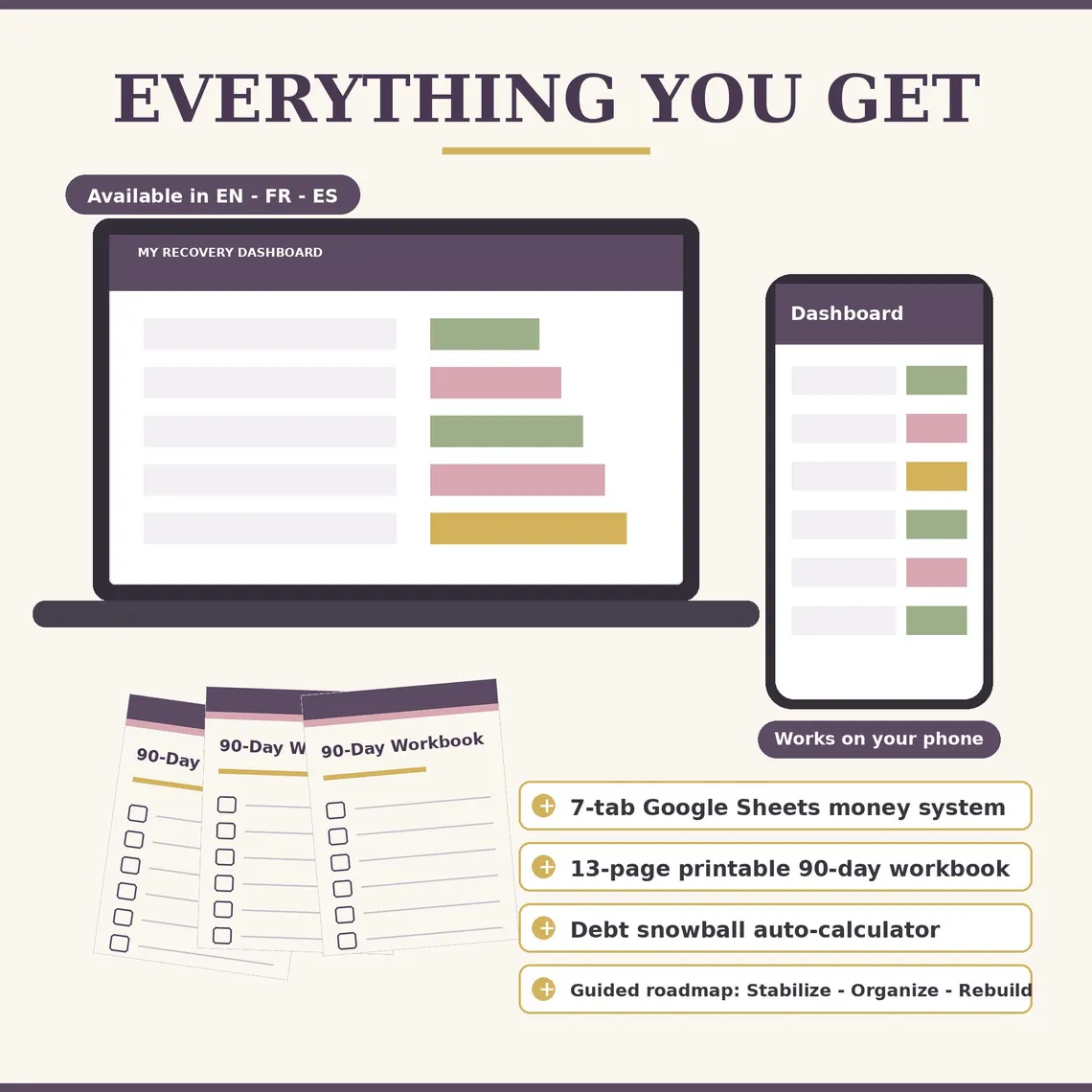
The Google Sheets system: seven tabs
- Dashboard: nine metrics fed by every other tab. Nothing is updated by hand.
- Financial inventory: every account, asset, debt and subscription in one list, with an action dropdown: close, transfer, remove ex.
- Monthly budget: your new solo numbers, planned against actual.
- Expense tracker: sixty rows with category dropdowns. Enough for one full month.
- Debt snowball calculator: ranks your debts smallest balance first and shows your monthly attack power.
- Emergency fund builder: target, saved, remaining and progress as a percentage.
- 90-day roadmap: 24 tasks across three phases with a progress bar that fills as you work.

Why you only fill the yellow cells
In the first version every cell was open. Testers deleted formulas by accident and broke the file. So I made one rule: you fill the yellow cells, the sheet calculates everything else. That rule lets someone who has never built a spreadsheet use the system without breaking it.
Why debts are ranked smallest first
Starting with the highest interest rate is mathematically cheaper. But in the months after a divorce the problem is not maths, it is continuing. Clearing the smallest debt gives a concrete win and keeps people in the system. So the calculator sorts by balance.

The 13-page printable workbook
Not everyone works in spreadsheets. The PDF gives you the same plan on paper: phase by phase checklists, fillable inventory, budget and debt pages, a credit rebuild checklist and a colourable emergency fund tracker. It also works on a tablet.
How it works
- Download instantly after purchase.
- Upload the Excel file to Google Sheets through File then Import. The formulas work immediately.
- Fill only the yellow cells.
- Print the PDF or use it on a tablet.
Where to get the Fresh Start planner
It is sold as an instant digital download, so nothing ships. French and Spanish versions are available in the same shop. Current price and all preview images are on the product page.
Build It Yourself: The Three-Tab Version
You do not have to buy a file. You can build the same plan in a blank Google Sheet. Three tabs will carry it.
1. Inventory tab
Columns: institution, account type, last four digits, whose name, balance, action, status. Make the action column a three-option dropdown: close, transfer, remove ex. Do not move on until this tab is finished.
2. Budget tab
Columns: line item, category, planned, actual, difference. Let a formula calculate the difference. Split lines into essential and optional. The essential total becomes the base of your emergency fund target.
3. Debt tab
Columns: creditor, remaining balance, minimum payment, interest rate, rank. Sort rank by remaining balance, smallest first. Pay extra on the top row and the minimum on the rest. When one clears, add its payment to the row above.
Those three tabs cover the backbone of the plan. The dashboard, the progress bar and the automatic ranking need formulas you have to write yourself. If you would rather not, the ready-made version saves you that work.
Five Things Not to Do in These 90 Days
These were the most repeated mistakes while testing the plan. All five are made with good intentions, and all five set the process back.
- Emptying your savings to clear debt. With no cash left, the next small emergency puts you straight back into borrowing. One month of buffer first, then debt.
- Making investment decisions in month one. Phase one is not about earning, it is about seeing the picture. Investment decisions come after the data.
- Closing every credit card at once. Closing cards lowers your total limit and pushes your utilisation ratio up. Check which card is your oldest before closing anything.
- Building the budget by halving the old one. Rent, internet and subscriptions do not divide by the number of people. Add it up from zero.
- Measuring progress by how you feel. One bad day can make a good month look like failure. Watch three numbers: credit score, total debt, emergency fund.
Free Resources Worth Using
- AnnualCreditReport.com is the official site for free credit reports from the three major US bureaus.
- Consumer Financial Protection Bureau publishes free guides on disputing credit report errors and dealing with debt collectors.
The Three Phases in Short
Step 1: Phase 1: Stabilise (days 1 to 30)
The goal of this phase is not to heal. It is to stop the bleeding. For the first month, make no investment decisions and pay off nothing early. Your only job is to find where your name appears and close that list.
Step 2: Phase 2: Organise (days 31 to 60)
The goal of this phase is to put an order on top of the list. By month two you know how much you have and where it goes. Now you make those numbers work for you.
Step 3: Phase 3: Rebuild (days 61 to 90)
The goal of this phase is to build a financial history in your own name. In month three you stop defending and start building. The results of this phase show up a year later.
Frequently Asked Questions
Where do you start financially after a divorce?
How much does living alone cost after a divorce?
Should I pay off the smallest debt or the highest interest first?
Should I close joint accounts immediately?
Does divorce hurt your credit score?
How big should an emergency fund be after divorce?
Why 90 days? Why not 30?
Can I build this system myself in Excel or Google Sheets?
What is inside the Fresh Start divorce financial planner?
Do I need to be good with spreadsheets to use it?
Does this plan work after a breakup, not just a divorce?
How do I measure progress?
Related Reading
How to Build an Annual Budget Spreadsheet You Still Use in March
When you are ready to turn the phase two budget into something permanent: three layers, 13 tabs and ten minutes a month, with the column names included.
Where to Start Today
Financial recovery after divorce is not a decision, it is an order of operations. First you find where your name appears. Then you put the numbers in shape. Last you build a history in your own name.
There is one thing you can do today. Open a blank page and start writing down the accounts with your name on them. Even the first ten lines take away the 2am question.
Three numbers to track: your credit score, your total debt balance and your emergency fund. Write all three today and again on day 90. The difference is your progress.
Author: Luna Intim x HerRescueKits
Last updated: 26 July 2026
Next review: January 2027